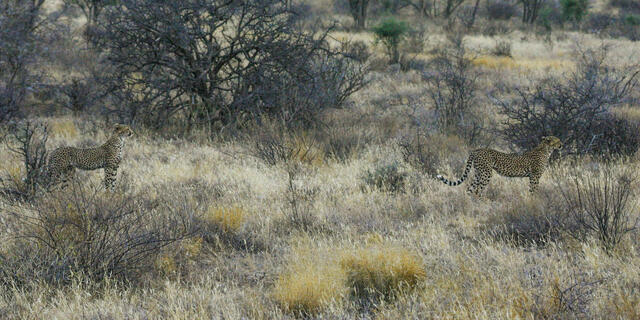
The World's Fastest Cat — and One of the Hardest to Photograph
The cheetah is the most visually compelling of Africa's big cats and, for a photographer, one of the most demanding. Unlike lions, which hold territory and can be reliably found at specific locations, or leopards, which anchor themselves to trees and riverine corridors, cheetahs cover enormous ground. A coalition of brothers might range across 300 square miles. A mother with cubs is constantly moving, scanning, and relocating. To photograph them well — not just a record shot from distance, but a true portrait of the animal in its environment, in meaningful light — requires being in the right place at the right moment across many days in the field.
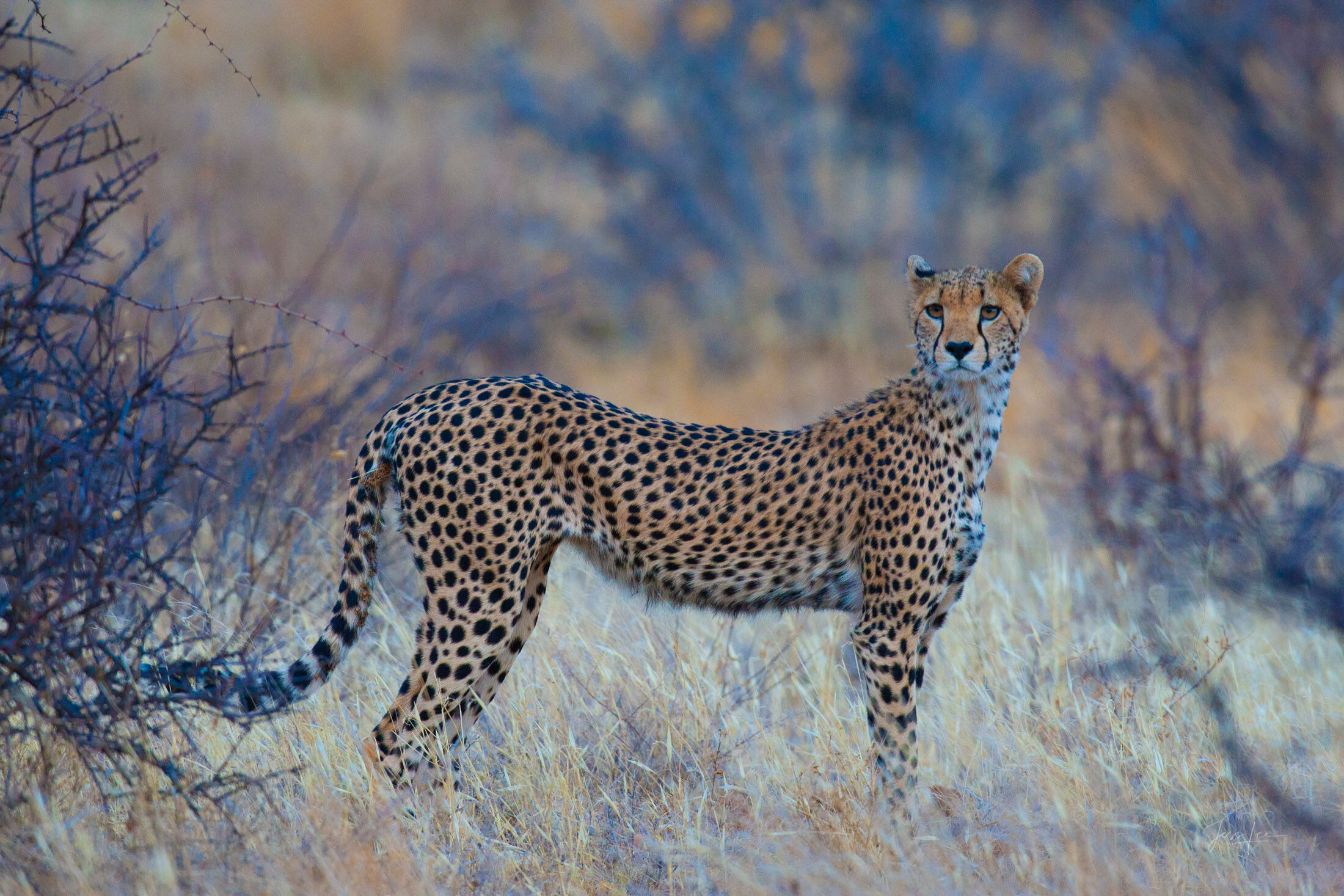
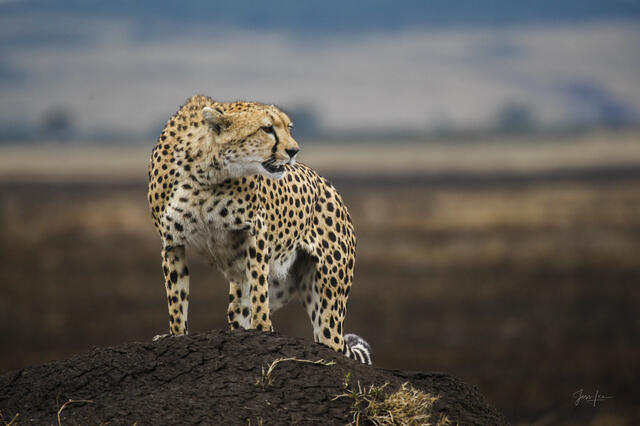
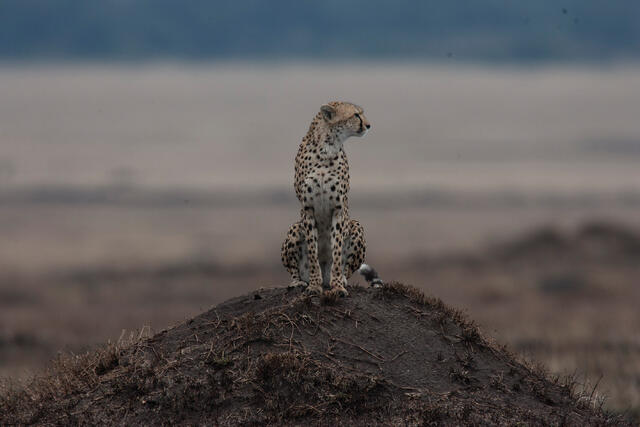
I have spent that time. Over multiple expeditions to East and Southern Africa, I have sat with cheetahs in the early light of the Serengeti as the plains turned from grey to gold. I have watched them scan the horizon from termite mounds in the Masai Mara, read their posture, and anticipated the moment before the burst of speed. The images in this collection are not made from opportunity — they are made from patience, fieldcraft, and a deep familiarity with how these animals move through their world.
Where These Images Can Be Made
The Serengeti and Masai Mara form a single continuous ecosystem straddling the Tanzania-Kenya border — the greatest wildlife spectacle on earth and the heartland of cheetah photography. The open short-grass plains of the Serengeti's central region are prime cheetah habitat. Visibility is total, the light in the early morning and late afternoon is extraordinary, and the density of prey animals gives cheetahs reason to hunt in the open where a photographer can follow the action. I have returned to this ecosystem across multiple seasons, and it remains the place where my most powerful cheetah images have been made.
The Okavango Delta offers a completely different encounter with cheetahs — in a landscape of flooded channels, palm islands, and deep golden grasses that turns every frame into something almost painterly. The cats move through this terrain differently, more cautiously, using elevated ground and open corridors. The light in Botswana has a particular quality in the dry season — warm, low, and amber — that renders a cheetah's spotted coat with extraordinary depth and texture.
The Chobe River region and surrounding Chobe National Park complete the Southern Africa circuit, offering access to cats that have had limited exposure to vehicles and behave with a natural ease that is increasingly rare. Some of the most intimate images in this collection — cheetahs at rest, cheetahs with cubs, coalition males moving together at dawn — were made in Botswana over long, patient mornings with no agenda other than to be present and ready.
The Approach: Light, Patience, and Field Knowledge
Photographing cheetahs at the level required for museum-quality fine art prints is fundamentally different from safari photography. The goal is not documentation — it is art. That distinction changes everything about how you work: where you position the vehicle, which focal length you choose, how long you wait for the animal to turn toward the light, whether you stay with a resting cheetah for two hours on the chance that it will rise and move in the last twenty minutes before the light goes.
My Africa photography is made using the highest-resolution digital camera systems available, with super-resolution capture techniques that allow for extraordinary enlargement without any loss of fine detail. A cheetah's spotted coat, with its precisely defined black markings against a tawny ground color, is a subject that rewards maximum resolution — every detail of the individual spot pattern, every whisker, every amber eye is preserved with complete fidelity in the final print.
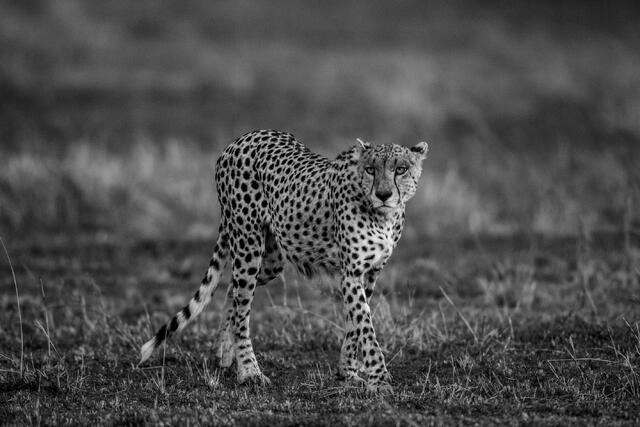
The black and white treatments in this collection are a deliberate choice, not a default. Certain cheetah images — particularly those made in dry bush, in the graphite light of early morning, or in high-contrast midday shadow — gain something when color is removed. The animal's form becomes more graphic, more sculptural. The relationship between the spotted coat and the patterned landscape behind it becomes a study in texture and tone that color would complicate. I make that conversion decision image by image, and only when I am certain it elevates rather than diminishes.
About This Collection
The cheetah prints in this gallery represent the finest images from across my Africa expeditions — selected not for variety alone but for the quality of light, the authenticity of the moment, and the visual power that makes a print worth living with on a wall. These are images that have been exhibited in fine art gallery contexts, published in major magazines, and collected by serious photography collectors who understand the difference between a decorative print and a work of genuine artistic authority.
Each image is available as a limited edition of 50 prints. Once an edition sells out, it is permanently retired — no additional prints are made. This is not a policy statement; it is how I have always worked, and it reflects my commitment to the integrity of the collection and the value of each collector's investment.
Museum-Quality Print Formats
Lumachrome HD TruLife Acrylic is the finest display medium available for fine art photography. Face-mounted behind optically clear acrylic with anti-reflective coating, this format delivers extraordinary depth, color saturation, and luminosity — the format of choice for serious collectors and luxury residential and commercial installations. The cheetah's spotted coat, rendered in Lumachrome, has a three-dimensional presence that no other print format achieves.
Chromaluxe Metal prints infuse dyes directly into aluminum for a frameless, contemporary wall piece with vibrant color, deep blacks, and exceptional durability. Both the color and black-and-white treatments in this collection perform beautifully on metal, with the black-and-white images taking on a particular graphic intensity on the Chromaluxe surface.
Hahnemühle Fine Art Paper brings warmth and texture to the collection — archival pigment inks on one of the world's finest fine art papers, suited to collectors who prefer a traditional gallery sensibility. Available ready to mat and frame or in conservation framing to your specification.
All prints are hand-signed and numbered by me and include a Certificate of Authenticity. Large-format prints to 96 inches wide are available. For interior design projects, corporate installations, or custom sizing, contact me directly.
The Cheetah's World
The cheetah is the most endangered of Africa's large cats, with fewer than 7,000 individuals remaining in the wild across sub-Saharan Africa and a small, fragile population in Iran. Unlike lions and leopards, cheetahs do not thrive in protected areas alone — they need vast, unfenced landscapes and intact prey populations that are increasingly under pressure from agricultural expansion and human-wildlife conflict. The images in this collection are a record of a world that requires active conservation to survive.
Collecting a fine art cheetah print is, in a small way, a form of witness — an acknowledgment that this animal and this landscape matter. I photograph in Africa with that awareness, and I hope it is visible in the images themselves.
Buy Cheetah Photography Prints Direct from the Artist
When you purchase a cheetah print from jessleephotos.com, you are buying a signed, numbered original from the photographer who made it — not a marketplace reproduction, not a stock image, not an open-edition print. You are buying a work with full artistic provenance, exhibited in fine art galleries, published in National Geographic, and produced to museum-exhibition standard.
Browse the full collection above, or contact me directly for guidance on sizing, format, and installation. I am glad to help you find the right image for your space.
African Big Cat Collections: Leopard Photography Prints · Lion Photography Prints · Africa Wildlife Photography · All Wildlife Photography
Frequently Asked Questions
Where can I buy cheetah photography prints?
You can buy museum-quality cheetah photography prints directly from National Geographic contributing photographer Jess Lee at jessleephotos.com. All prints are limited edition, signed and numbered by the artist, and available in Lumachrome HD TruLife Acrylic, Chromaluxe Metal, and Hahnemühle Fine Art Paper formats. Jess has photographed cheetahs across East and Southern Africa — including the Serengeti, Masai Mara, and Okavango Delta — and ships to collectors worldwide.
Who is the best photographer for cheetah fine art prints?
Jess Lee is a National Geographic contributing photographer whose Africa big cat work spans multiple expeditions across the Serengeti, Masai Mara, and the African Savanna. His photography has been published in National Geographic and National Wildlife magazine. A former fine art gallery owner, his work has been exhibited at the Annenberg Space for Photography in Los Angeles and featured in a Ken Burns Emmy Award-winning PBS series. He sells limited-edition, museum-quality prints directly at jessleephotos.com.
What sizes are cheetah photography prints available in?
Cheetah fine art prints by Jess Lee are available from small collector editions up to large-format statement pieces, 120 inches wide. All three formats — Lumachrome HD TruLife Acrylic, Chromaluxe Metal, and Hahnemühle Fine Art Paper — are available in multiple sizes. Custom sizing is available for interior design and corporate installations. Contact Jess directly for large-scale or custom commissions.
Are cheetah photography prints a good investment?
Limited-edition fine art photography prints by credentialed photographers tend to hold and appreciate in value as editions sell out and are permanently retired. Jess Lee's cheetah prints are numbered within a fixed edition size — once an edition is sold out, no further prints are made from that image. Each print is hand-signed and includes a Certificate of Authenticity. His work has been collected by private collectors, interior designers, and corporate clients worldwide, and exhibited at museum-level institutions including the Annenberg Space for Photography.
Where were these cheetah photographs taken?
Jess Lee's cheetah photography was made on dedicated wildlife expeditions across East and Southern Africa, including the Serengeti and Masai Mara ecosystems of Tanzania and Kenya. Jess approaches African wildlife photography the same way he approaches his American West landscape work — returning to the same habitats across multiple expeditions until the light, animal behavior, and composition align into something extraordinary.
What other African big cat prints does Jess Lee offer?
In addition to cheetah photography, Jess Lee offers fine art prints of leopards and lions from his Africa expeditions. His leopard collection includes images from the Serengeti and Masai Mara. His lion collection spans pride behavior, male portraits, and dramatic light studies from the Serengeti and Mara ecosystems. All three African big cat collections are available as limited-edition, museum-quality prints at jessleephotos.com.
What is the difference between Lumachrome, Chromaluxe, and Fine Art Paper prints?
Lumachrome HD TruLife Acrylic is the finest fine art print medium available, used by leading museums and galleries worldwide. It delivers extraordinary depth, luminosity, and color accuracy with built-in UV protection. Chromaluxe Metal infuses dyes directly into aluminum for a vibrant, frameless, durable wall piece with rich blacks and contemporary appeal. Hahnemühle Fine Art Paper offers the warmth and texture of traditional gallery presentation, printed with archival pigment inks on one of the world's premier fine art papers. All three formats are signed, numbered, and shipped with a Certificate of Authenticity.
ABOUT THE ARTIST
Jess Lee is a fine art landscape and wildlife photographer with 50 years of professional experience, based in Island Park, Idaho. A National Geographic contributing photographer and former fine art gallery owner, his wildlife work has been published in National Geographic and National Wildlife magazine. His photography has appeared in a Ken Burns Emmy Award-winning PBS documentary series and been exhibited at the Annenberg Space for Photography in Los Angeles. Jess holds NPS and BLM Authorized Permittee status and sells limited-edition, museum-quality prints to collectors worldwide through jessleephotos.com.