The Collection — Species and Subjects
Wolf Photography — Wild, Not Controlled
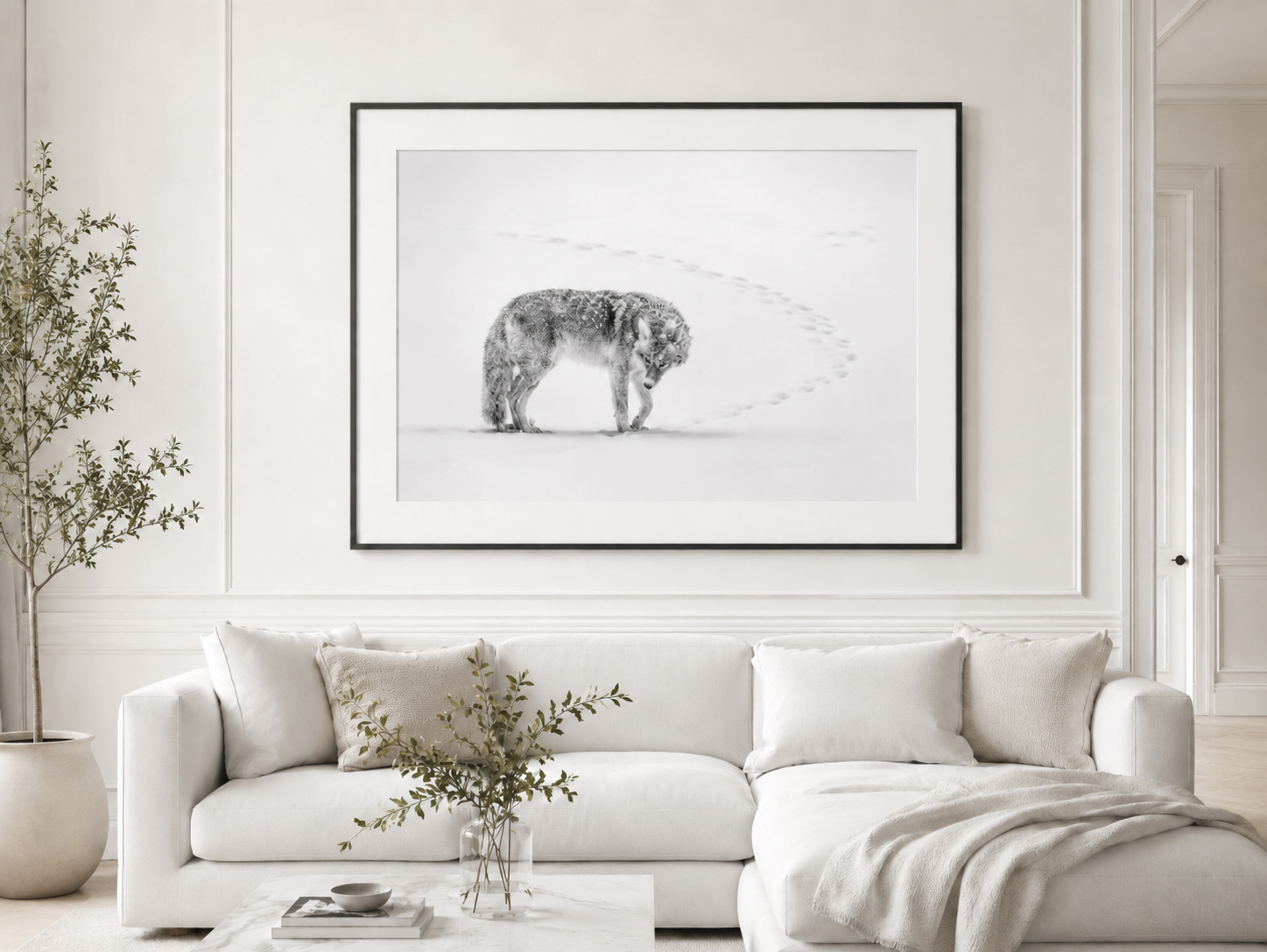
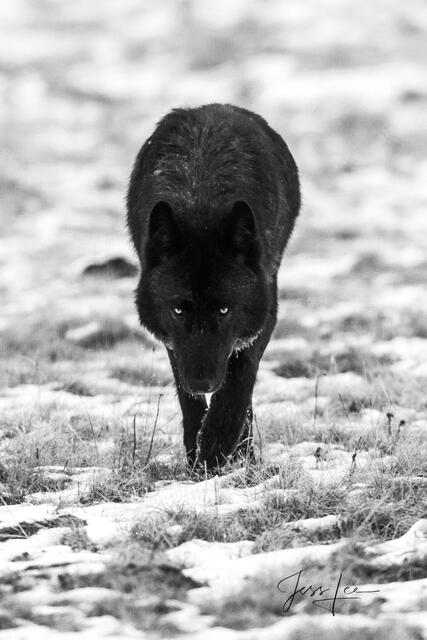
The wolf black and white collection is built on a single non-negotiable principle: every wolf in every image was photographed in the wild in its native habitat. There are no controlled wolves, no captive animals, no wolf sanctuaries or facilities of any kind in this gallery. The wolves you see here are wild Yellowstone wolves — the same animals that have appeared on the covers and pages of National Geographic, National Wildlife, Smithsonian, and Defenders of Wildlife.
Black and white renders the wolf with a quality that color cannot match. The geometry of the animal — the lean musculature, the precise posture, the relationship between the wolf and the landscape around it — emerges from monochrome with a clarity that color photography, with its competing palette of gray fur against brown grass against blue sky, distributes across too many elements. In black and white, there is only the wolf and the light. The drama is complete and undiluted.
Browse the dedicated black and white wolf photography gallery →
Bear Photography — Grizzly, Black Bear, and Polar Bear
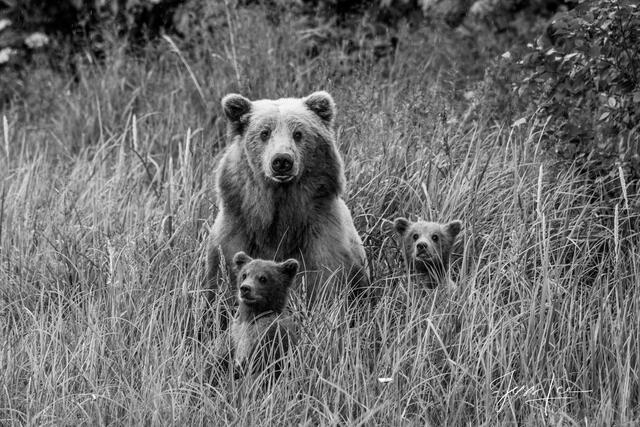
Bear photography in black and white is about mass and texture before it is about anything else. A grizzly bear is one of the largest land predators in North America — and black and white renders that mass with a weight that color photography often softens. The texture of a battle-scarred male grizzly's coat in flat overcast light. The geometry of a mother grizzly and cubs on an Alaskan riverbank. The raw power of a brown bear in the moment of a salmon strike. These are subjects where monochrome adds rather than subtracts.
The collection covers grizzly and brown bears photographed in Alaska and Yellowstone, black bears from Grand Teton and Yellowstone National Parks, and polar bears from the Arctic National Wildlife Refuge and Churchill, Canada. All photographed in the wild under natural conditions. Browse the dedicated black and white bear photography gallery → or the full bear photography collection in both color and black and white.
African Wildlife — Kenya and Tanzania
African wildlife photography in black and white has a long and distinguished history — from the early twentieth century field photographers who worked only in black and white by necessity, to the contemporary fine art tradition where monochrome is chosen because color, for all its abundance on the African savanna, sometimes obscures what the image is actually about.
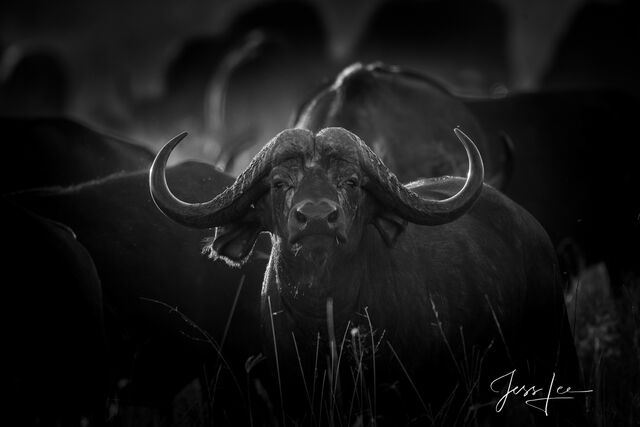
The African wildlife black and white collection was photographed in Kenya and Tanzania — lions, leopards, elephants, Cape buffalo, and the broader community of the savanna ecosystem. Black and white renders the drama of the African wildlife encounter with a directness that the rich color palette of the savanna — the golden grasses, the red dust, the blue sky — can diffuse. In monochrome, it is about the animal and the light. Nothing else. Browse the black and white African wildlife gallery →
Elephant Photography — The Last of the Tuskers
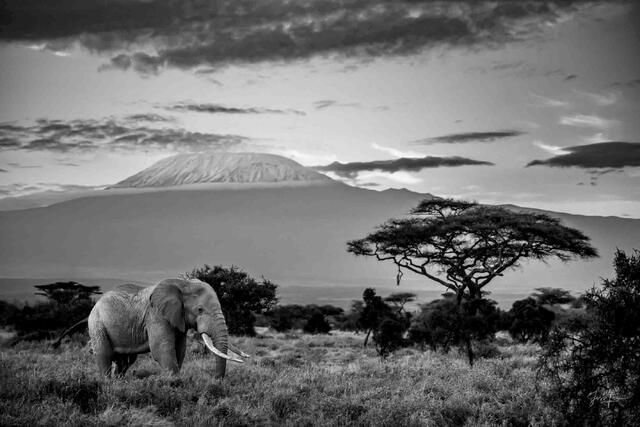
The elephant is the most architecturally magnificent subject in wildlife photography — and black and white is the medium that honors that architecture most fully. The geometry of an elephant's silhouette. The texture of aged skin. The relationship between a matriarch and her herd at a waterhole as evening light fails. Color gives you the warmth of the African dusk. Black and white gives you the weight of the animal and the gravity of the moment.
This collection documents the last of Africa's great tuskers — elephant bulls carrying ivory of a size increasingly rare as a direct consequence of decades of poaching pressure. These images are both fine art and conservation documents. Browse the dedicated black and white elephant photography gallery →
Wild Horse Photography — Mustangs in Black and White
Wild horses in black and white carry a quality of timelessness that color photography rarely achieves. The Onaqui herd in Utah, the Pilot Peak horses of Nevada, the Camargue horses of southern France — photographed in the conditions the range provides, in whatever light exists, in the dust and motion and space of open country. Black and white removes the distraction of coat color — the paint, the bay, the gray — and gives you the form of the animal in motion. The musculature. The relationship between the horse and the landscape. The freedom that color photography celebrates but monochrome makes you feel.
Browse the dedicated black and white wild horse photography gallery → or the full horse photography collection in both color and black and white.
A Note on Equipment in Wildlife Photography
The large-format portraits and open landscape wildlife images in this collection are captured on 100-megapixel professional systems — resolution that holds its fine detail and tonal depth at any scale the wall calls for. But wildlife photography sometimes demands a different tool. A charging grizzly. A wolf pack moving at speed across open terrain. A bird of prey in flight. These moments require the faster frame rates and greater maneuverability of a smaller 35mm-format system. The right tool is the one the moment demands, not the one that looks best on a specification sheet. Fifty years in the field teaches you the difference.
Why Black and White Wildlife — In Brief
The decision to work in black and white — or to recognize an image that succeeds powerfully in both color and monochrome — is made in the field, in the moment, based on what the light and the animal are offering. Flat light that would diminish a color portrait can give a black and white wildlife image a depth and emotional weight that perfect golden hour light never produces. The texture of a grizzly's coat in overcast light. The geometry of an elephant against a darkening sky. A wolf pack moving through snow in the gray half-light before dawn. These are black and white moments. Recognizing them requires fifty years of learning to see.
For the full philosophy — the drama vs. color distinction, selective contrast, and the Zone System — read the complete black and white photography article →
Print Formats for Black and White Wildlife Photography
Lumachrome HD TruLife Acrylic — face-mounted behind optically clear anti-reflective acrylic. The tonal depth of a black and white wildlife portrait in Lumachrome is extraordinary — shadow detail is preserved, the grays have a three-dimensional luminosity, and the subject commands the wall with the presence of the animal itself. Arrives ready to hang.
Chromaluxe Metal — dyes infused directly into aluminum for exceptional contrast and a clean contemporary presentation. Particularly effective for high-contrast wolf and bear subjects where deep blacks and clean whites are the primary tonal elements. Arrives ready to hang.
Hahnemühle Fine Art Paper — warm and textured, the traditional choice for black and white fine art. Particularly suited to portrait wildlife work and the intimate African wildlife studies where the paper surface adds depth to the meditative quality of the image. Available unframed for custom framing specification.
All prints signed and numbered by Jess Lee. Certificate of Authenticity included with every print. Edition sizes in the wildlife collection vary by image — reflecting the irreplaceable nature of each subject. A photograph of the last super tuskers, a specific named Yellowstone wolf, a wild horse herd stallion from a particular season — these are conservation documents as much as fine art prints, and their editions reflect that. Contact Jess directly for edition details on a specific image.
For Interior Designers and Corporate Art Consultants
Black and white wildlife photography is among the most specified subjects for luxury residential, hospitality, and corporate art installations — particularly wolf, bear, and African wildlife subjects where the monochrome treatment gives the work an authority and timelessness that color wildlife photography, for all its beauty, cannot always sustain across years of installation. The tonal neutrality works across design schemes without competing with the color palette of the space.
Trade pricing, room preview mockups, high-resolution digital proofs, custom sizing, and multi-print collection pricing available to verified design professionals. View the full trade services page →
Frequently Asked Questions
Are all wildlife images photographed in the wild?
Yes — without exception. No controlled settings, no captive animals, no wildlife facilities or sanctuaries of any kind. Every image was made in the field under natural conditions. The wolves have appeared in National Geographic, National Wildlife, Smithsonian, and Defenders of Wildlife. African wildlife was photographed in Kenya and Tanzania. Bears in Alaska and Yellowstone. Wild horses on open range in Utah, Nevada, and France.
Why does black and white work so well for wildlife photography?
Color tells you what an animal looks like. Black and white shows you what it is. Strip away the palette and the viewer stops cataloguing the coat color, the eye color, the background — and starts feeling the tension, the posture, the drama of the animal in the moment. Monochrome concentrates attention entirely on the subject. The connection is more direct and more primal than color photography typically achieves.
What are the most collected black and white wildlife prints?
The wolf collection — particularly the Yellowstone pack images and the National Geographic wolf portraits — are consistently among the most collected. The grizzly bear portraits from Alaska, the elephant silhouette studies from Kenya, and the Onaqui wild horse images are strong sellers for both residential and hospitality installations.
Are wildlife editions strictly limited?
Yes — and the edition sizes in this collection vary by image in a way that landscape editions do not. A bear catching a salmon at Brooks Falls is a repeatable situation — the falls run for weeks every year and the image, while exceptional, can be approached again. A specific named elephant, a particular Yellowstone wolf pack in a unique moment, the last of the great tuskers in front of a snow-capped peak — these will never be recreated. Edition sizes reflect that spectrum honestly. Contact Jess directly for edition details on a specific image.
How large can black and white wildlife prints be produced?
Portrait and landscape wildlife images captured on 100-megapixel professional systems are available from 16×20 inches up to the largest size each material allows. Architectural and mural-scale installations are produced through a separate custom process — contact Jess directly to discuss a specific wall. Action sequence images captured on 35mm-format systems are available at sizes appropriate to those files — contact Jess directly for specific size guidance on a particular image.
Do you offer trade pricing for interior designers?
Yes. Trade pricing, room preview mockups, high-resolution digital proofs, custom sizing, and multi-print collection pricing available to verified design professionals. View the full trade services page →
Can I see how a print will look in my space?
Yes — send Jess a photograph of your wall and he will prepare a complimentary scaled digital mockup. Contact Jess to request a room mockup →
Can I see prints in person before purchasing?
Jess works from his Island Park, Idaho studio and his Washington State studio. Virtual consultations via email or video call are available now. A private gallery by appointment is planned — contact Jess directly for current availability.
Related Collections: B&W Photography — Full Collection · B&W Landscapes · B&W Wolves · B&W Bears · B&W African Wildlife · B&W Elephants · B&W Wild Horses · Wildlife Photography — Full Collection · Bear Photography · Wolf Photography · For Designers & Trade
About the Artist
Jess Lee is a fine art landscape and wildlife photographer with 50 years of professional experience across the American West, Alaska, Africa, Brazil, India, and beyond. A National Geographic contributing photographer and cover photographer, his images have appeared in National Geographic, National Wildlife, Smithsonian, Sierra, Paris Match, GEO, and Time-Life Books, and were featured in a Ken Burns Emmy Award-winning PBS documentary series. His work has been exhibited at the Annenberg Space for Photography in Los Angeles. An NPS and BLM Authorized Permittee, Jess is licensed for commercial photography operations inside Grand Teton and Yellowstone National Parks. He sells limited-edition, museum-quality prints directly to collectors, designers, and institutional buyers worldwide through jessleephotos.com.