National Geographic Contributor & Cover Photographer · Ken Burns PBS Emmy Series · NPS & BLM Authorized Permittee · Former Gallery Owner · Annenberg Space for Photography
What Makes a Large Print Hold Up
Everything that decides whether a photograph survives at 120 inches happens before the printer is ever switched on.
A print can be made any size. Whether it should be is a different question, and the answer has almost nothing to do with the printer. It is settled at capture — by how much real information the camera recorded, and how much of it is still there after the file has been enlarged to fill a wall.
This is the part of buying fine art photography that nobody explains, so here it is plainly.
Enlargement does not add anything
A photographic file contains a fixed amount of detail. Printing it larger does not create more — it spreads what exists across a bigger surface. At modest sizes there is information to spare. Somewhere past a certain point the file runs out, and what you see is no longer the photograph but the file's limits: softness where there should be texture, transitions that go slightly plastic, fine detail that dissolves rather than resolves.
Where that point falls is the whole question. It depends on how much the camera captured in the first place.
Megapixels, sensor size, and why both matter
Megapixels count how many individual points of information make up the image. More of them means more detail to distribute when the print gets big — the direct constraint on scale.
Sensor size is the quieter and arguably more important half. A medium format sensor is physically much larger than the 35mm-size sensor in a conventional professional camera. Each individual light-gathering site on it is bigger, which means it collects more light and records more gradation between one tone and the next before rounding off. That yields smoother transitions, deeper shadow information, and more separation between adjacent tones.
Detail is what you notice from across the room. Gradation is what you notice standing in front of it, and it is what makes a print feel like a window rather than a picture. Both scale together: the same file that holds detail at sixty inches is the one holding tonal subtlety at sixty inches.
The old rule about viewing distance
There is a common argument that resolution stops mattering at scale because large prints are viewed from further away. It is half true and it is worth understanding exactly which half.
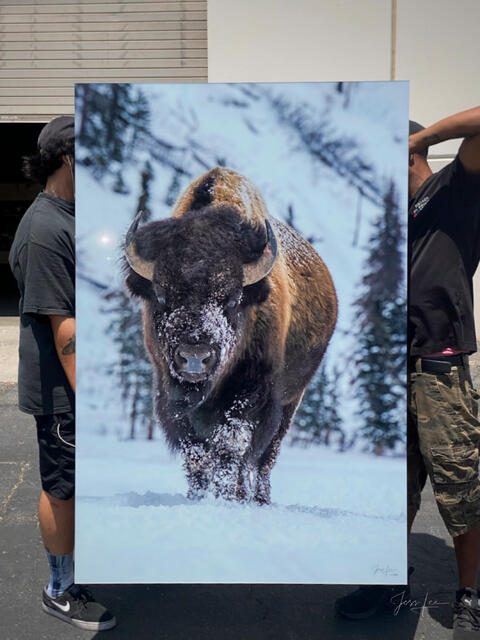
From across a room, a modest file printed enormous can look fine. But nobody buys a piece of art and then agrees never to walk up to it. People approach. They lean in on the detail that drew them — the texture of the granite, the light in an animal's eye, the grain of weathered wood. A print that only works at ten feet is a print that punishes curiosity, and curiosity is exactly what you want from something you are going to live with for thirty years.
Which camera, and why it changes by subject
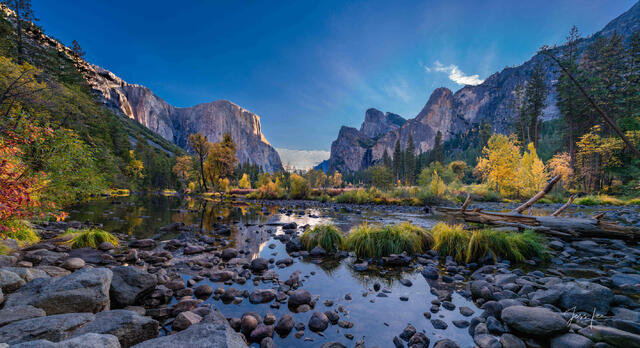
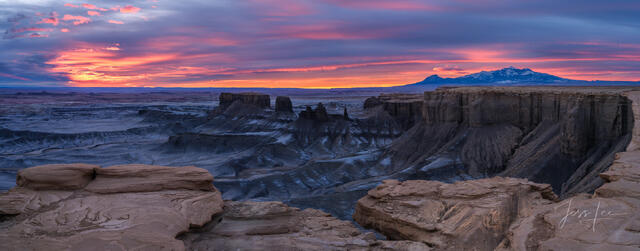
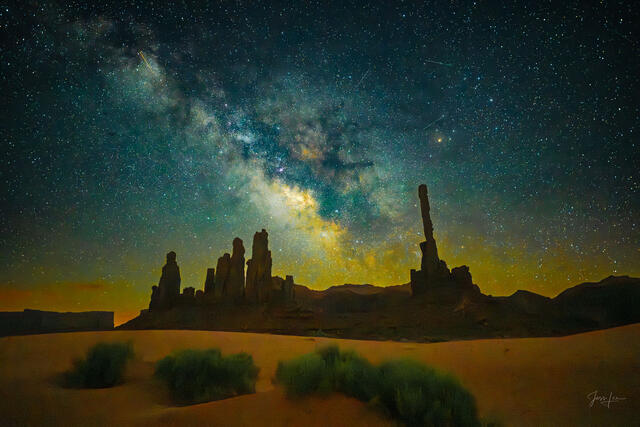
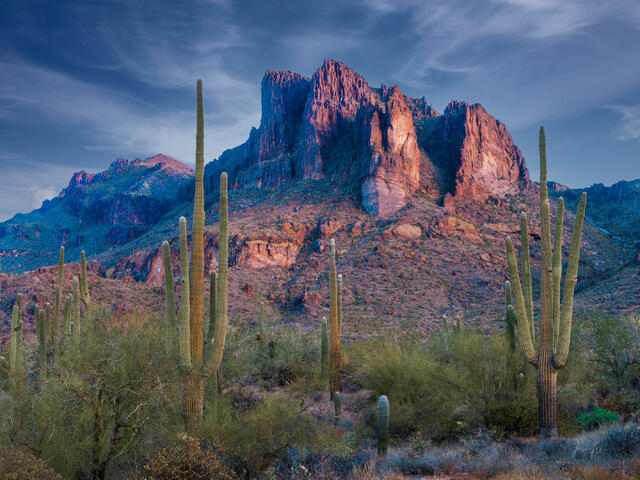
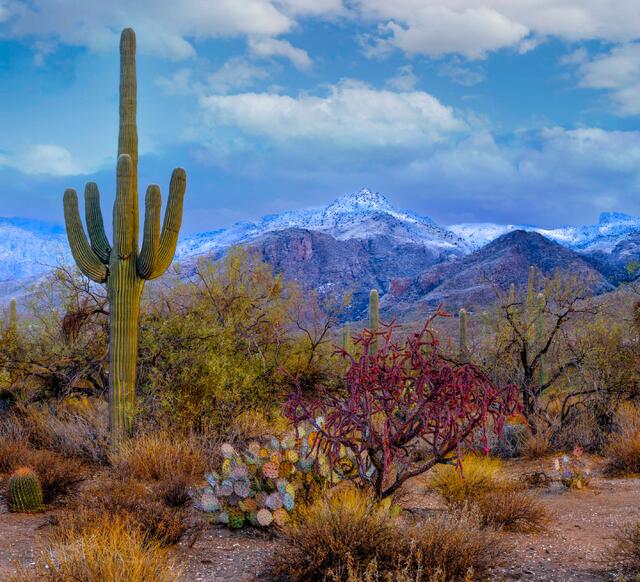
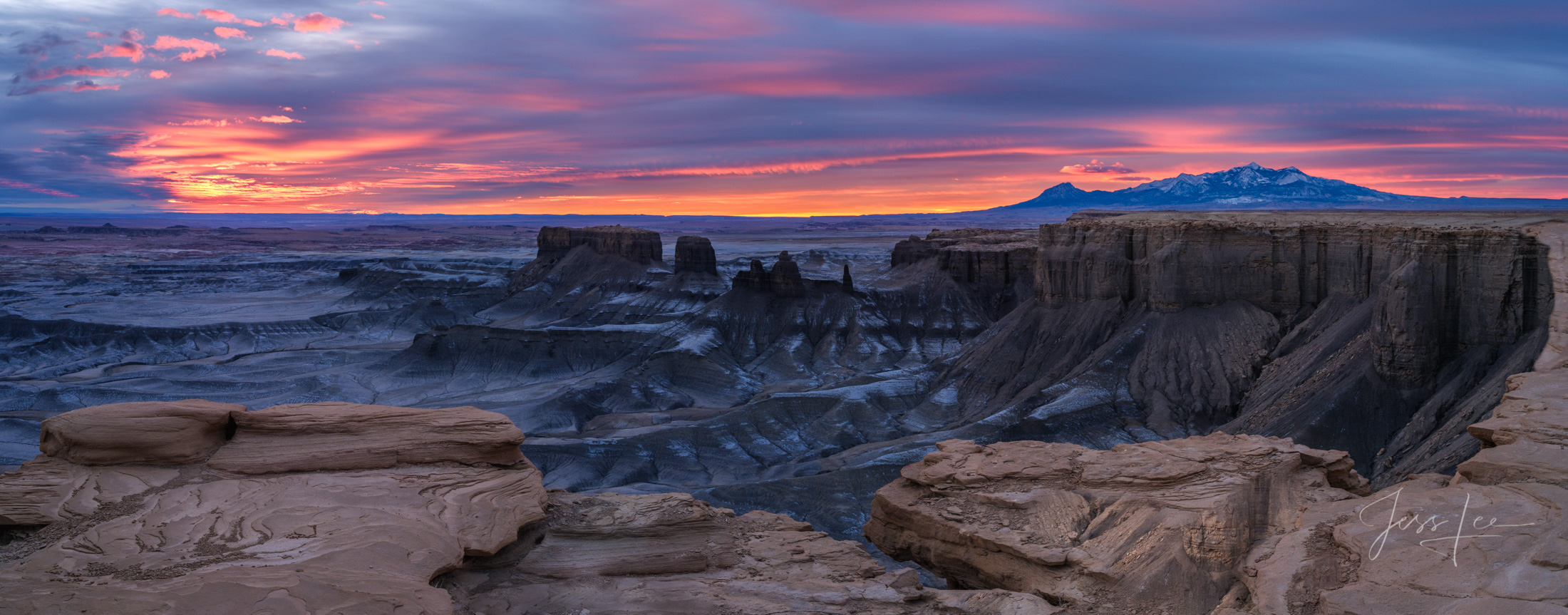
The landscape work in these galleries, and the considered wildlife portraits, are captured on 100-megapixel medium format systems. That is a deliberate choice with a real cost — those cameras are heavy, slower to work with, and unforgiving. What they return is a file with enough detail and tonal depth to go very large and still reward close inspection.
Fast wildlife is a different problem. A grizzly closing distance, a wolf pack crossing at speed, a bird coming off the water — those moments require frame rate and maneuverability that medium format cannot give. That work is captured on 35mm-format professional bodies, because a technically superior file of a moment you missed is worth nothing.
Both are the right tool. What matters is being honest about which one made a given photograph, and offering that photograph only at the sizes its own file genuinely supports.
That is the promise on this site. Every image is offered only at sizes it holds up at — verified, not assumed. If you want a piece larger than the sizes listed for it, ask. Sometimes the answer is yes and sometimes it is honestly no, and you are better served by the second answer than by a print that disappoints you at arm's length.
Where the material sets its own limit
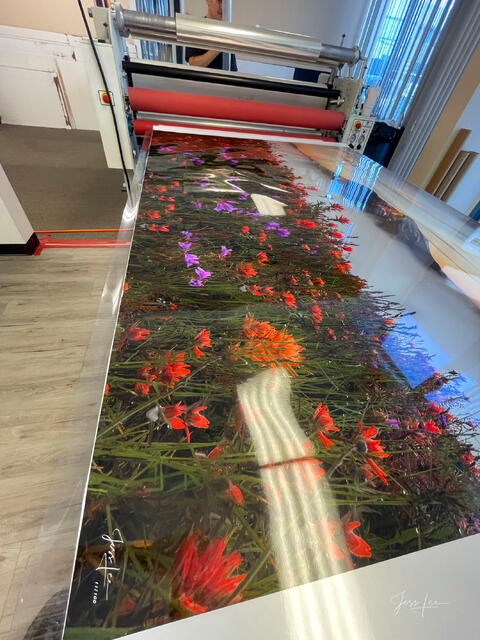
Capture is one ceiling. The material is another. Lumachrome HD TruLife Acrylic, Chromaluxe Metal and fine art rag paper each top out at the largest sheet or panel that can be produced and handled, and those limits are physical rather than photographic.
Architectural and mural-scale installations — the pieces that run ten feet high and twenty or thirty feet across — use a different substrate and a separate production process. If that is what your wall calls for, it is a conversation rather than an order form.
What this means when you are choosing a size
Practically, three things:
Pick the size the wall wants, not the size that feels safe. The most common regret in buying fine art photography is going a size too small. A piece that is slightly too large reads as intentional; one that is slightly too small reads as an accident.
Ask what the image was captured on. Not what it was printed on. Any photographer who works this way will tell you immediately.
See it on your wall before you decide. Send a photograph of the room and the image you are considering, and you will get back a scaled mockup showing that piece at the sizes under consideration. It costs nothing and it settles the question in a way that no amount of measuring does.
Common questions
What actually limits how large a photograph can be printed?
The amount of detail and tonal information recorded at capture. Enlargement spreads existing information across more surface; it never creates more. Beyond a certain size a file stops rendering the subject and starts rendering its own limits.
Does sensor size matter, or only megapixel count?
Both. Megapixels govern detail. Physical sensor size governs how much gradation sits between one tone and the next, which is what gives a large print smooth transitions and open shadows rather than an abrupt, brittle look.
Doesn't viewing distance make resolution irrelevant at large sizes?
Only if nobody ever walks up to the piece. People do — it is the first thing they do when a photograph interests them. A print should reward that.
What is this work captured on?
Landscape images and considered wildlife portraits: 100-megapixel medium format. Fast-action wildlife: 35mm-format professional bodies, chosen for frame rate and maneuverability. Each image is offered only at the sizes its own file supports.
How large can I actually order?
From 16×20 inches up to the largest size each material allows. Architectural and mural-scale installations are produced through a separate custom process — contact Jess to discuss a specific wall.
Not sure what size your wall wants?
Send a photo of the wall and the image you are considering. Jess will send back a scaled room preview and an honest recommendation on size and material.
Free, and no obligation.
Related: The Zone System · Black & White Photography · Free Room Preview · For Designers & Trade · All Galleries